

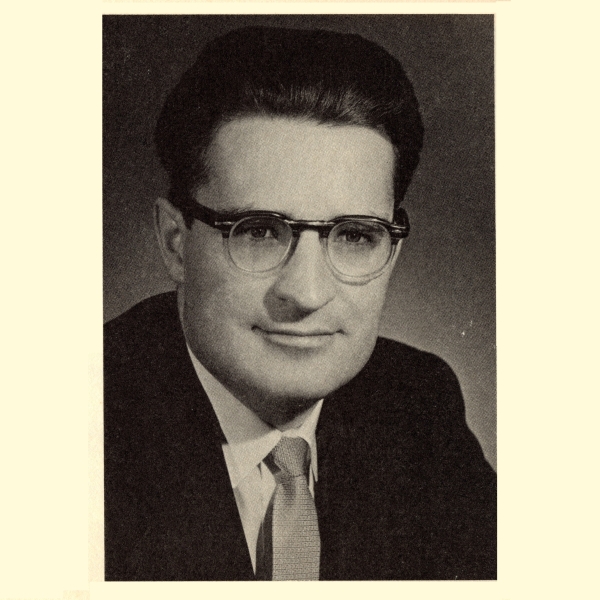
Eugen (Friedrich) Gmeiner. Organist, teacher, b Bucharest, of Austrian parents, 26 Aug 1927, naturalized Canadian 1962, d Halifax 17 May 1977; M MUS (Michigan) 1967. He studied with Karl Walter at the Vienna Academy of Music and graduated in 1949. He was an organist-choirmaster 1951-6 in Vienna and often gave organ recitals on Austrian radio. In 1956 he emigrated to Canada. He taught 1956-77 at Acadia University, where he also was university organist. He subsequently studied with Marilyn Mason at the University of Michigan. The winner of the 1962 National (USA) Organ Competition, Gmeiner performed extensively in Canada, the USA, and Europe and was recognized as an outstanding Bach interpreter.
“If you want beauty, you must be able to face the truth and truth is always a hard thing to face and live with, because truth is very exacting.” — E. F. Gmeiner
A truly international man – this was Eugen Friedrich Gmeiner. He has been called Austrian, but only because Vienna was the European city of his longest duration and early adulthood. It was Canada that beckoned to him – the land of opportunity, the land of ‘open spaces’, and it was here that he chose to spend the last twenty years of his life.
Music was second nature to Friedl Gmeiner. Born in Bucharest, Roumania in 1927, he came from a family to whom music was almost the quintessence of existence. An aunt and uncle were voice teachers; another aunt, a pianist; his mother, a very able accompanist; but most notably, his aunt, Lula Muis Gmeiner, was the famous European Lieder singer who sang for Kaiser Wilhelm II of Germany, and Tsar Nicholar II of Russia. After court engagements, depending on whether a concert had pleased him, the custom was for the monarch to offer a performer the choice of either a commission or a title. Lula Gmeiner, on one such occasion, having been offered her choice, asked for both a commission and title, and received them. This is only part of the musical heritage with which Friedl grew up.
It is difficult to ascertain how early in life Friedl became consciously aware of music. Through stories he related to family and friends, he told of hearing strains of violin music wafting through the walls of a neigh- bouring Wohnung in the apartment building in which he lived in Berlin. At the age of four, he became enchanted and begged his parents to give him violin lessons. They were delighted, but knowing how short- lived a child’s interest could be, postponed the commencement of his training until he was six years old, at which time he began formal violin instruction, and at age eight. piano.
As a child and youth, Friedl became a very competent violinist. During the 1930’s, his family moved to Czechoslovakia, and it was here, at the age of fifteen, that Friedl played with a professional orchestra. But as times change, so do interests, and after Friedl had heard some especially fine organ music, he became engrossed with the organ’s capability of producing polyphonic sound and was determined to master it. As a self-taught organist, he passed the entrance examinations into the School of Organ of the Austrian State Academy of Music, Vienna, from which he graduated with highest distinction in 1949. While a student at the Academy, he was the regularly appointed organist and choir-master of Christ Church, the British Embassy Church in Vienna. "Visitors to Christ Church usually notice the excellence of the organ music which is in the hands of Mr. Gmeiner." - Christ Church Messenger, March, 1949.
Following his graduation, Friedl spent one year in London, England, where he pursued individual studies of organ and church music under the sponsorship of the Educational Interchange Council, a branch of the British Council. In late 1950 he returned to Vienna where he served as organist with the title of Stad-organist at the Evangelical Reformed (Presbyterian) City Church. During these years he gave numerous organ recitals, formed and directed a youth choir, played organ broadcasts and conducted choral and orchestral performances for the Austrian Radio Network. In addition, Friedl did freelance work – arranging music, private teaching, accompanying singers and instrumentalists, and occasionally acting as assistant recording manager for the Vienna studio of Westminster Records.
In 1956, Friedl immigrated to Canada where he was appointed Instructor of Organ at Acadia University, Wolfville, and Organist and Choir Director of the Wolfville Baptist Church. The following year, in addition to his instructorship, he was appointed University Organist.
In 1958 he founded the Acadia Chorale, which toured and appeared on radio and television presenting choral literature rarely heard in the Atlantic Provinces at that time. A promotion to the rank of Assistant Professor with tenure came the same year.
In 1962, Friedl became a Canadian citizen. This year also marked one of the highlights of Friedl’s professional career; he won first place in the National Organ Competition at Fort Wayne, Indiana, a distinction no other Canadian has yet attained. 1963 was an outstanding year for Friedl. He supervised and assisted the installation of the Neo-Baroque organ built to his specifications (1963 Casavant, two manuals, 21 stops, mechanical key and stop action) in Acadia University’s Manning Memorial Chapel. Commemorating the event, Friedl conducted a special Organ Summer Academy, featuring E. Power Biggs who gave two inaugural recitals on the new organ. In 1964 Friedl appeared three times in the Halifax St. Mary's Basilica Concert Series as organ soloist. That year Friedl gave the first of his many CBC broadcasts originating from the Manning Memorial Chapel.
"It is impossible for me to estimate the number of recitals which I have given over the years since my arrival to Canada. The CBC’s estimate of productions originating from the Manning Chapel is fifty-five to sixty, not counting repeat broadcasts." – E. F. Gmeiner
He appeared, as well, on CBC Television with the Acadia Chapel Choir. under the direction of Prof. Leonard Mayoh, in a program of choral music and organ solo works. In 1965 Friedl performed a special organ recital for Bishop Hayes in the presence of many distinguished visitors, including the Papal Nuntius, at St. Mary’s Basilica, Halifax, on the occasion of Bishop Hayes’ Consecration as Bishop.
On sabbatical leave in 1966-67, Friedl studied at the University of Michigan with Dr. Marilyn Mason and received the Master of Music degree in August, 1967. At EXPO ’67 he was featured in seven organ recitals at the Canadian Pavilion’s Concert Hall which contained an organ very like the Manning Memorial Chapel organ. In 1968 he performed an all-Bach recital and shared another concert with Nevenka Rovan for the Nova Scotia Festival of the Arts, held on the Acadia Campus.
"Prof. Eugen Gmeiner concluded the Festival's outstanding musical programs with an all-Bach recital. This was a rare treat. Prof. Gmeiner played three Kyries, the Canzona in D minor, the Prelude and Fugue in A minor, two small chorale preludes, and concluded with the Fantasia and Fugue in G Minor. No finer ending for the Festival could be found than this intensely dramatic composition with its overwhelming conclusion. Enthusiastic applause drew forth an encore." – Victor D. Snarr, The Advertiser, Kentville, August 15, 1968.
Promotion to the rank of Associate Professor came in 1969, and in 1969-70 he received a Canada Council Senior Arts Fellowship. During this time, he pursued individual studies in Austria, and gave two organ recitals while there, one in the famous St. Stephen’s Cathedral of Vienna.
In 1972, Friedl spent five weeks in Edmundston, New Brunswick, working on the splendid French classical organ (1967 Casavant, three manuals, 38 stops, mechanical action with electric stop action) where he recorded four programmes for the CBC.
In 1974 he attended the Annual Organ Conference at the University of Michigan where he presented in recital the Four Great Leipzig Preludes & Fugues by J. S. Bach. In 1975 he played the opening concert of a series of fourteen, covering all of Bach's organ works, at the University of Western Ontario. Promotion to the rank of Full Professor at Acadia University came in May, 1977.
Friedl Gmeiner was a beloved and highly skilled teacher. Over the years, his students have done well, some of them competing with great success in major music festivals. He initiated a seminar course ‘Organ Methods and Materials’ in which the principles of organ design, instrument maintenance and tuning, plus a variety of practical aspects related to the organ are introduced. Friedl’s love of the music of Johann Sebastian Bach was well known. In an interview with Dr. Peter Smale he said:
"I must disagree with you that Bach is an intellectual composer. Bach takes me ’way beyond fascination with technical expertise. Composition is not to any extent a matter of technique for Bach. That is mere child’s play for him. This summer I was practising a six-part fugue and I played each part separately. They were all integral wholes. Bach does not ‘pad’ his composition to make it work. It is mind-boggling how he treats structures with such ease and it is that which sets his works apart from other musical experiences. Bach elevates me to extreme emotional heights. No, it is more than emotional; it is cosmic ."
The two Chorale Preludes Nun danket alle Gott and Schmücke dich, o liebe Seele, from the 17 Chorales, Leipzig period. 1738-1750.
“Scarcely could a great volume describe the deep musical and spiritual significance of the numerous Bach organ compositions based on Lutheran chorales. Out of Bach’s fusion of faith and artistry come many such works in a fantastic variety of forms of great expressiveness, and with much musical symbolism discernible.”
— Program notes of E. F. Gmeiner
“In the four part arrangement Nun danket alle Gott the fugatos preceding the entrance of the individual hymn lines in the soprano approach the idiom of Pachelbel in their simplicity. The purity and strength of an early woodcut seems to be recaptured here.”
——Johann Sebastian Bach, Karl Gerringer
"Schmücke dich, o liebe Seele is perhaps the loveliest of jewels among Bach’s many chorale preludes. Dealing with the very center of the Christian ritual — The Communion — it is of an introspection and mysticism which were so much Bach’s own. In the last bars the bass ascends a full octave and a half only to fall to the lower octave no less than three times, a typically cryptic symbolization of the elevation. Robert Schumann, reviewing the historic Bach organ concert of Mendelssohn who played in that concert this chorale prelude, wrote ‘as priceless and profound a piece of music as ever sprang from an artist's imagination.’ "
— Program notes of E. F. Gmeiner
LISTEN:
Two of the Four Great Leipzig Preludes & Fugues - Prelude & Fugue in B minor and Prelude & Fugue in E minor.
The number of preludes and fugues for the organ Bach wrote in Leipzig was very small. Approximately half a dozen works of this kind seem to have been completed during the composer's final creative period. These preludes and fugues exhibit the composer’s tendency to combine various stylistic elements within the realm of keyboard music. They are highly significant, and some of them belong to the best works Bach ever wrote. The first movement of the Prelude & Fugue in B minor presents a structure similar to that in the C minor Prelude. In its melodic idiom this tender and poignant piece assumes, however, the character of an aria imbued with gentle nostalgia. The fugue fittingly conveys a mood of quiet restraint. Only toward the end does the composition discard its reticence and move to an imposing climax. The Prelude & Fugue in E minor is one of Bach’s most powerful and extensive organ compositions. Spitta rightly calls it an ‘organ symphony in two movements.’ The mighty prelude is again indebted to the concerto form, but as the main material of the episodes grows out of the main ritornello, the cohesion of all sections is particularly strong. The fugue is known in English-speaking countries as ‘The Wedge’, since the beginning of its theme, containing one ascending and one descending line, gradually widens from the interval of a third to that of an octave. This huge and extremely difficult movement introduces, after a brilliant contrapuntal development of the theme, a strongly contrasting section. Here free passages and runs are presented, while the ‘Wedge’ theme appears only occasionally. In conclusion the fugal part from the beginning is literally restated, and it reveals the working of Bach’s mind that the middle section is almost exactly as long as the two outer parts together. In this magnificent work, full of vigor, verve, and brilliance, elements of the concerto, the toccata, and the da capo aria are fused together with singular success.
LISTEN:
The Toccata & Fugue in D minor
Possibly the most striking and best-known organ work from Bach’s youth, is the Toccata in D minor. Strongly rhapsodic sections start and conclude the work. The freely flowing fugue in the centre is loosely constructed, with runs and broken chord episodes separating the different entrances of the theme. Obviously Bach wished to maintain the predominant character of brilliant improvisation even in the middle section. The theme seems to be inspired by the violinistic technique of playing in quick alternation on two neighboring strings, a device Bach was often to employ in his music for keyboard instruments. The toccata’s torrents of sound and dazzling fireworks create a tone poem of passionate subjectivity; yet there is a masterly craftsmanship underlying all this out- pouring of emotion. The work was written by an organist with so deep an insight into the possibilities of the instrument that he was able to produce the most powerful effects without unduly taxing the player's technical abilities. In its intensity and exuberance this is clearly a product of Bach’s youth, but there ‘is no groping and uncertainty in it.
(Notes on the Four Great Leipzig Preludes & Fugues and the Toccata & Fugue in D minor were taken from Karl Gerringer’s Johann Sebastian Bach, a text which Prof. Gmeiner often used).
LISTEN: